Notes · 20 July 2024
Reading a shophouse front
The broad styles, from plain early houses to Art Deco, and the plaster, tiles and shutters that tell them apart.
Most of the old streets on these walks are lined with shophouses: narrow buildings of two or three storeys, built in long terraces, with a shop or workshop on the ground floor and rooms above. They went up from the middle of the 1800s to the 1960s, and their fronts changed with the fashion of each decade. Once you know the broad styles, a walk down any row becomes a quiet game of dating the houses.
The usual guides sort them into about six styles. The dates overlap, and owners often redid a front long after the house was built, so treat them as a rough order rather than a rule.
The early houses
The oldest fronts are plain and low: two storeys, one or two simple windows upstairs, timber shutters and little decoration beyond a moulded line under the roof. Few survive unchanged, but a low, quiet house between two taller neighbours is often the oldest in the row.
The ornate years
From about 1900 the fronts grow taller and busier. The upper floor usually has three windows, often with fanlights above them, and the wall between them carries plaster pilasters, garlands and moulded panels. Glazed tiles appear on the pilasters and under the windows, with flowers, birds and fruit in bright colours; many were made in Europe or Japan and shipped out. This is the style most people picture when they think of a shophouse, and it lasted into the 1930s.
Joo Chiat and Koon Seng Road are the place to see it at its fullest. The Old Streets walk passes rows where every house has its own colour and its own set of tiles, with the plaster picked out in a second or third shade.
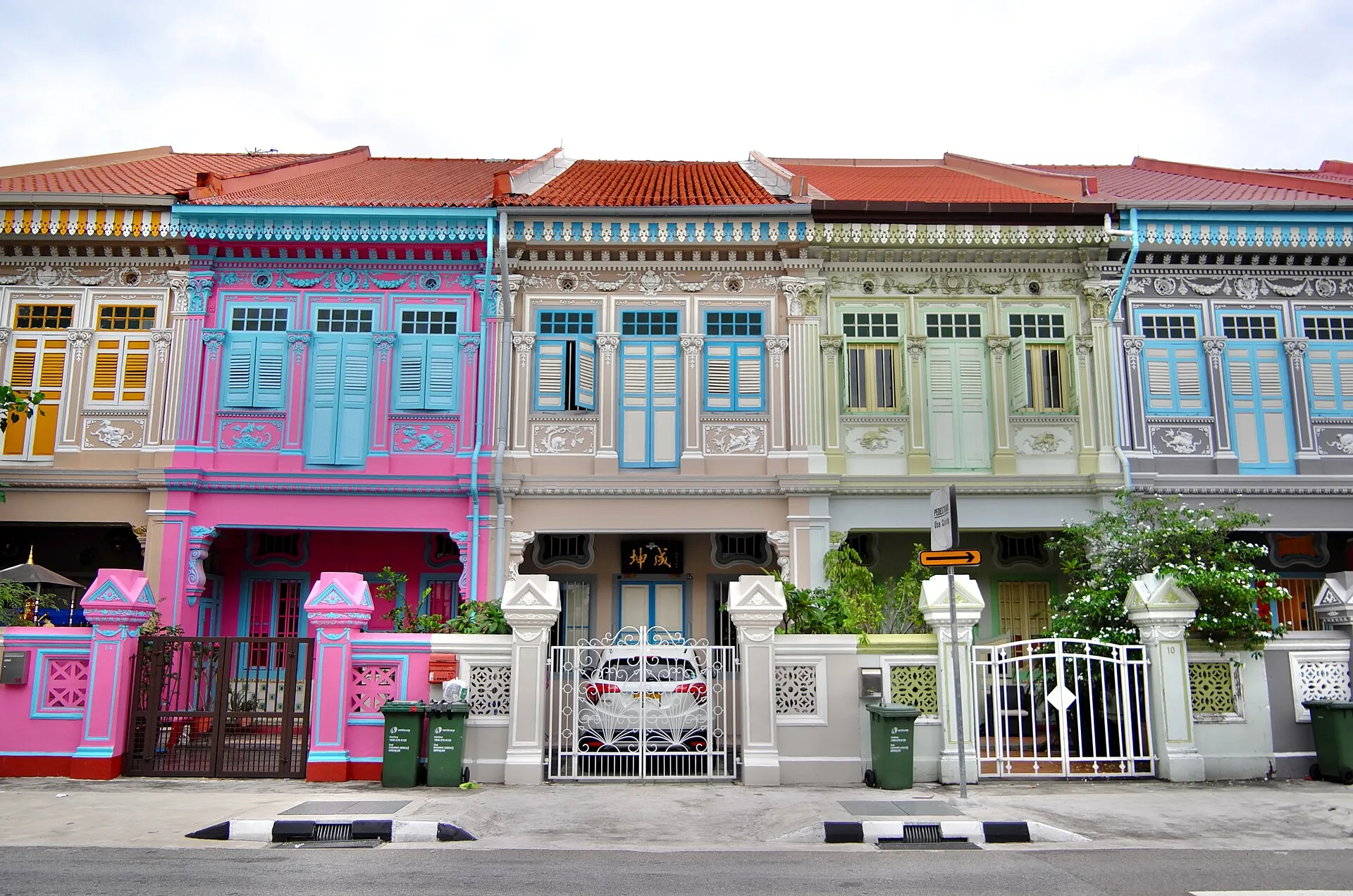
Plaster, shutters and tiles along one terrace · 2014 · Photo: Kate Branch, CC BY-SA 4.0, via Wikimedia Commons

Toward straight lines
In the 1930s the decoration thins out. Art Deco fronts are flatter, with stepped tops, vertical fins and geometric patterns cast into the plaster, and sometimes the year of building in a panel at the top. After the war the plain style goes further still: smooth walls, concrete sun shades over the windows and almost no ornament at all. These later houses are easy to walk past, but their clean lines photograph well in hard light.
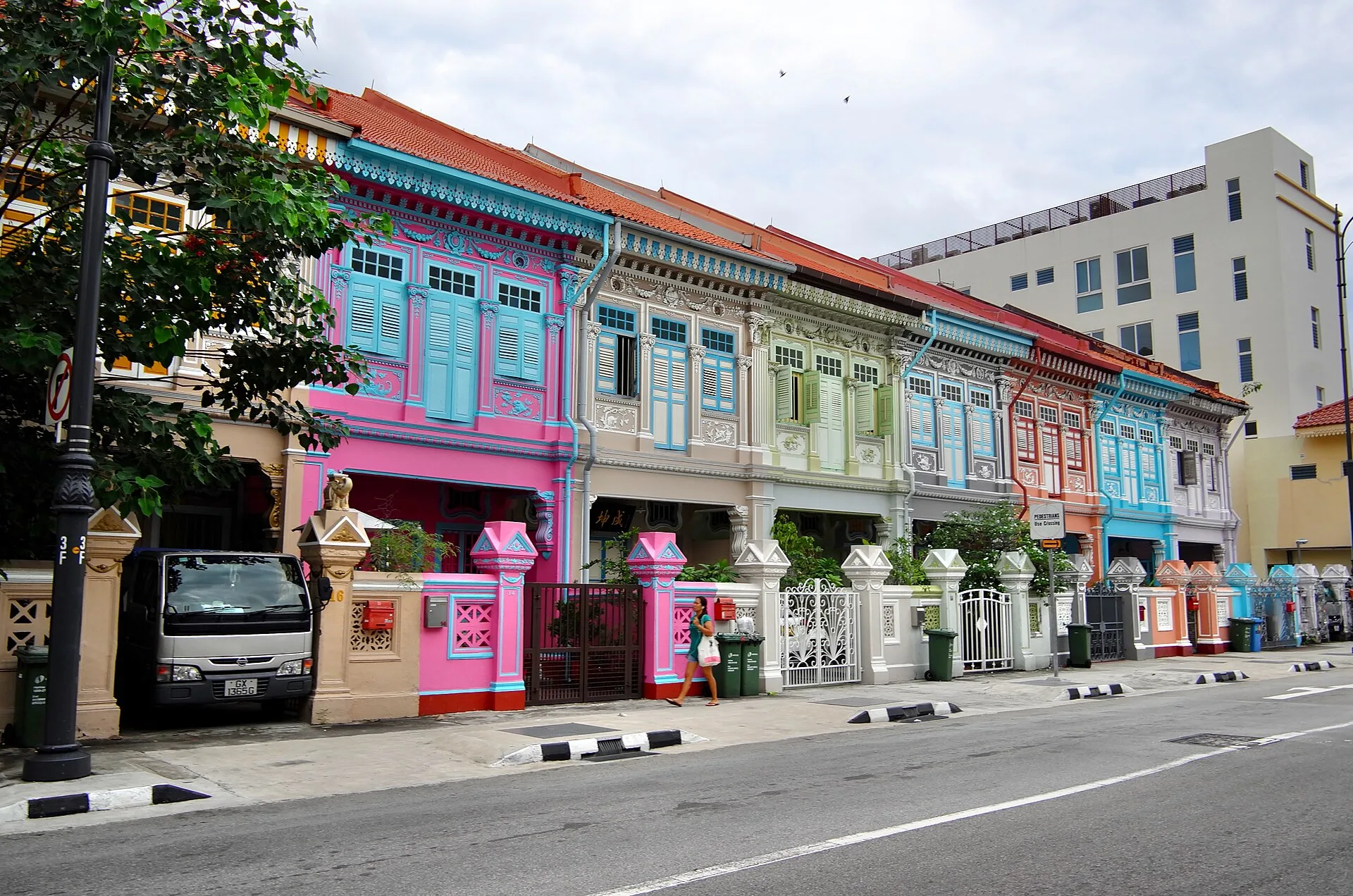
A pink house at the end of a terrace · 2014 · Photo: Kate Branch, CC BY-SA 4.0, via Wikimedia Commons

What to look for
A few details help on any street. Count the windows on the upper floor: one or two suggests an early house, three a later one. Look at the top of the front for a date or a family name in raised letters. Check the pilasters for tiles, and the windows for timber shutters with adjustable slats, which kept the rooms dim and let the air through. Look down, too: the covered passage in front of each shop is part of the design, and the floor tiles there often match the house.
Many fronts have been repainted in brighter colours than they ever had, and some are new buildings behind old faces. That is part of the story as well. The best time to look is early in the morning, when the light is low enough to throw the plaster into relief and the street is still quiet.
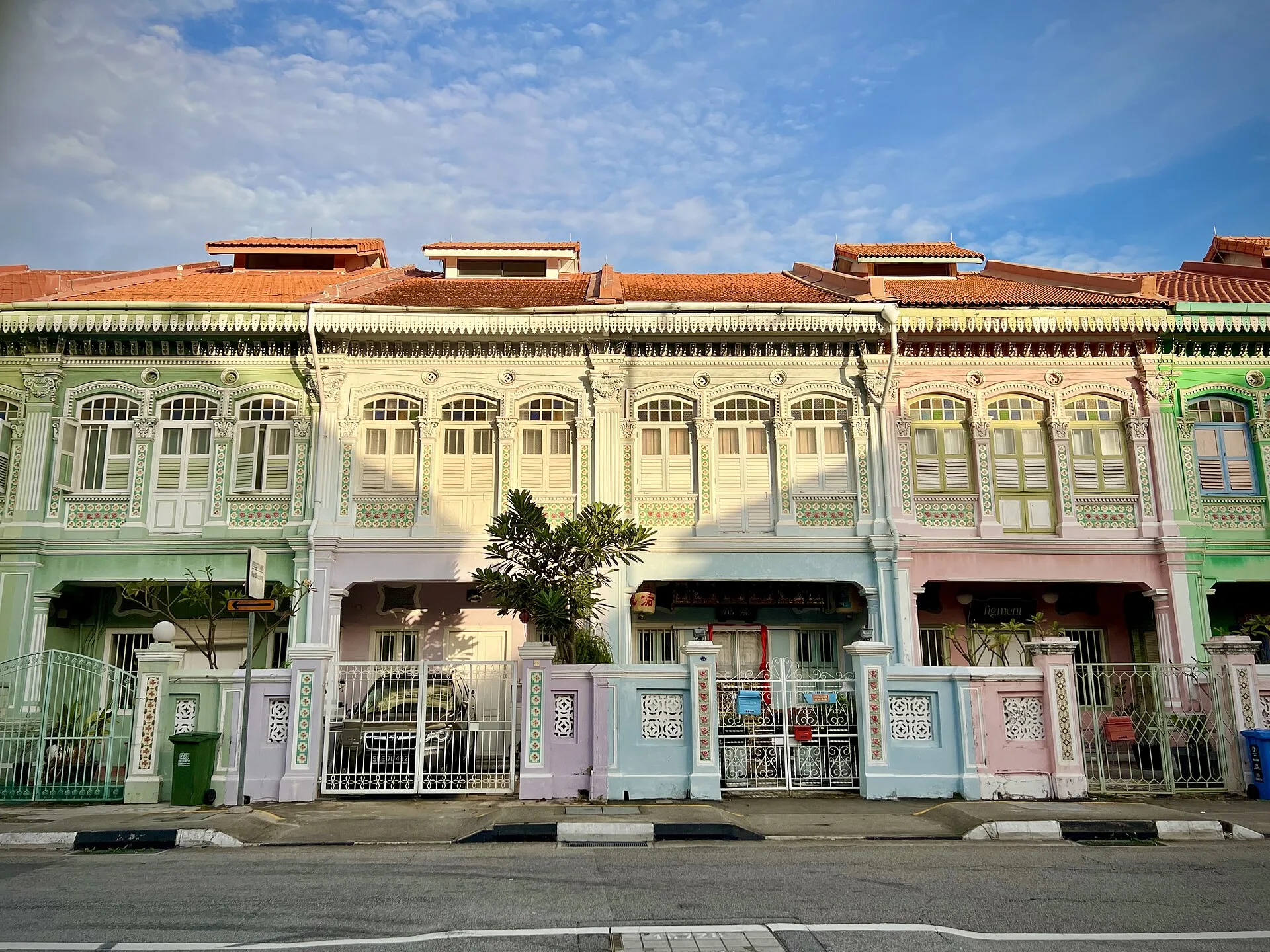
The painted terraces of Koon Seng Road · 2024 · Photo: Sharon Hahn Darlin, CC BY 2.0, via Wikimedia Commons
